


Emily Weiss: “I learned how to be a mother in Denmark”
Glossier founder Emily Weiss is expecting her second child and planning a home birth in the home she has made in Copenhagen. Here she talks about falling for the city, the decision she made at thirty-two, and about letting motherhood change her.
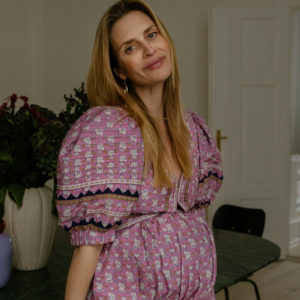
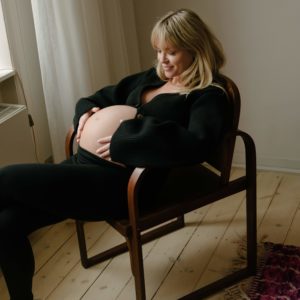
Emily Weiss is thirty-eight weeks pregnant with her second child. In a few weeks she will give birth in the home she and her family have made in Copenhagen. The birth pool was delivered a week ago.
In love with Copenhagen
The question of why an American entrepreneur chooses to spend so much time in Denmark – and to have her second child here – is one she gets daily.
“The long and short answer is that I love Copenhagen. It’s a complete love affair. Perhaps I was Danish in a past life. But I have no family here. My partner is not from here. There’s no logical reason. It’s a spiritual connection.”
The connection goes back fifteen years. She was working as an assistant to a stylist at Vogue in New York, and one of the models the team often worked with was a very young Caroline Bille Brahe, then Brasch-Nielsen.
“Every time I’d be sitting on the floor tying her shoe or helping her zip up a dress, she would say, ‘Oh, you should really come visit me in Copenhagen.’ At the time, Copenhagen wasn’t what it is today. I honestly didn’t even know where it was.”
Eventually she went. And what stayed with her was neither the food nor the architecture.
“It was this sense of belonging. Between the community and people. I had never experienced such a strong sense of relationality as I have in Copenhagen. People looking out for each other. That’s really the spirit and the energy that I fell in love with, and I’ve been coming back ever since.”
“I’ve never once spoken to an OBGYN”
When Emily became a mother four years ago to her daughter Clara, it was her Danish friends and their families she looked to.
“I learned how to be a mother here. There’s an innate trust that women have in the process of motherhood and birth. That doesn’t mean people don’t have their fears, hardships and their Google searches in the middle of the night. I’m sure that’s universal. But there’s a real trust in oneself, in one’s body, in your baby. A real partnership with your child, a teammate – as opposed to a process to be controlled, or a person to be managed. Something that needs to be fixed.”
The contrast to the American system is stark. In the US, maternity care is largely private and physician-led, and midwifery has historically had little standing within the hospital system.
“In my prenatal care here I’ve never once spoken to an OBGYN. In the US it’s the opposite,” she says.
“Thank God for science, thank God for medicine. So many of my friends have needed it. But at the same time there’s just a lot of unnecessary intervention, a lot of birth trauma, and on a more spiritual level, an experience that has been sort of robbed from women. The chance to go through this rite of passage in a really confident and empowered and self-trusted way.”
And the pressure doesn’t stop at the birth, she says.
“From there you go straight into a very capitalistic early childhood environment. Sleep training, what books do you need to read, what products do you need to buy to get your baby to sleep or perform or learn faster. None of it serves to build confidence.”

A childhood with no words for the body
Emily Weiss grew up in the northeastern United States in what she describes as a fairly typical upper middle class family. Her father worked, her mother stayed home. What strikes her most today is the relationship to the body.
“We didn’t really have that authentic relationship to our bodies that I see people, and women, have in Copenhagen. A real comfort with nudity, with physiological processes, with periods. I just remember never hearing about it from my mom. So it was such a mystery to me – and when you don’t know what’s coming, there’s shame.”
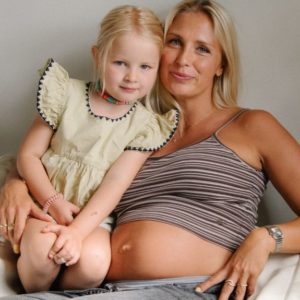
It is one of the things she has deliberately done differently with her four-year-old daughter, Clara.
“She’s been passing me tampons since she was one year old. And early on I decided I would never say something negative about my body in front of her.” She pauses for a moment. “What’s interesting is that it has changed what I feel about my body. I don’t have nearly the amount of criticisms I might have had fifteen years ago. Walking that walk with my own child, I’ve ended up retraining myself.”
She has also shown Clara the video of her own birth since she was two.
“I don’t think birth should be something scary. Think of all the movies of women screaming. American media in particular has portrayed birth as highly medical and terrifying – something you’re totally unprepared for and need other people to do for you.”
She remembers a meeting with her midwife, Abby, in Los Angeles, where she said that Abby was going to deliver the baby.
“She stopped me. ‘No. You’re going to deliver the baby. I don’t deliver the baby.'” Emily shakes her head. “The whole difference is right there in the language.”
“I didn’t become a woman until my thirties”
Before motherhood came ten years in which Emily launched first the blog Into The Gloss and then the beauty brand Glossier, which grew into one of the most talked-about in the world. But it began on a much smaller scale: with her visiting women in their own homes and going through their bathroom shelves.
“In some ways I would call my entire twenties a late adolescence. I wouldn’t necessarily call it womanhood. I think womanhood was really my thirties. I don’t think I really became a woman until I was thirty, thirty-one, thirty-two.”
That was exactly what preoccupied her at the time.”I was thinking a lot about what it meant to be a woman. What is a woman? Who is a woman? What qualities do I appreciate in the women around me, the women I look up to, the women I work for? That was really what Into The Gloss was about. And beauty was a great way of learning about women.”
She describes it as a way in. “It’s such a good gateway into who someone is, how someone thinks about themselves, and how they orient in the world. Beauty is a great icebreaker. It was a real way of opening up a one-hour conversation with someone, with some type of starting point. But we would go on tangents, and I’d learn about their childhoods and their love lives and their insecurities. All of it.”
Freezing her eggs at thirty-two
In 2019, Emily chose not only to freeze her eggs but to talk about it publicly. She was thirty-two, divorced, in a new relationship, and at the peak of her career, with Glossier going a million miles an hour.
“I thought: I have the means to do this. It’s insurance. There are so few reasons not to do it, and so many good reasons to do it.”
She ran the scenarios in her head. Perhaps she would have all her children naturally and never need the eggs. Perhaps the first naturally, and help with the second in her late thirties. Or perhaps she wouldn’t be able to conceive naturally at all when she finally felt ready – and then having eggs on ice would truly be insurance.
“There were just so many unknowns. And it’s a one-month – pretty unpleasant, let’s not forget – process.” She laughs. “If you’re going to go through it, I’d suggest doing it in January, when there’s nothing going on and you can sit at home in the dark and watch Netflix and be hormonal without feeling like you’re missing out.”
The child she is expecting now came from those eggs. At forty, the chance of conceiving in any given cycle is low.
“I could either sit here and try for another two years, or I could unfreeze my eggs. Five weeks later I was pregnant, on the first transfer.” She adds immediately: “I know it doesn’t always go that easily, and that there can be a lot of heartbreak in it. But it’s probably the decision I’m most grateful to my younger self for having made.”
Clara was conceived without help. She came as a surprise in the middle of the pandemic, when Emily was thirty-seven and living in Malibu.
“It was the happiest surprise of my entire life. I really feel like she came down to say, ‘It’s time.'” She pauses. “Before that, I’d found the decision hard to make. I knew I was longing to be a mom, and that I was ready. But actually pulling the trigger – I’m sort of glad she made it for me.”
The closest to God and to death
Emily prepared thoroughly for the birth, but in her own way.
“I go into things wholeheartedly. But it was more spiritual and anthropological than it was a business or spreadsheet approach.” Among other things, she read Transformed by Birth by the childbirth educator Britta Bushnell, who also holds a PhD in Greek mythology. “That’s a good example of my approach. One part of me was thinking: how have women been doing this forever? I want to know that story. And another part was drawn to the less seen and more felt aspects of the transition.”
Choosing a home birth suits who Emily is. “It’s so me. I’m experiential. I want to go all in.” She thinks for a moment. “Birth is the biggest psychedelic trip you can go on in this life. It was the closest to God I’ve ever felt. And the closest to death I’ve ever felt.”
“And I’m happy I did it. It was incredibly painful. It broke me open in so many ways.”
Clara’s birth took four and a half hours from start to finish. It began around four in the afternoon, and she remembers smiling ear to ear when she realised it was happening. She texted her midwife and doula to say she thought she’d have the baby before midnight. They wrote back telling her to get out of her logical brain – labour for a first-time mother averages eighteen hours.
“I remember thinking: I’m going to surf this. And I’m not a surfer,” she laughs. “But that was the feeling. Go with the flow.”
She spent an hour and a half in the outdoor bathtub she’d set up when she and her partner Will moved into the house in Malibu. Then everything happened fast. She ended up on the bedroom floor as the pushing phase began, and beside her she had what – along with Will – became her most important companion during the birth: a furry dog bed.
“There was something about the touch of that faux fur. I was kneading it like a cat.” She laughs again. “It was not on my bingo card for giving birth.”
And then she got frightened. Because for everything she had read and prepared, there was one thing nobody had told her.
“That the pushing phase is completely involuntary. It’s a reflex. It’s a totally different set of muscles than contractions, and it isn’t something you decide to do. So when my body started to push the baby out all on its own, I thought something had gone terribly wrong.”
She dissociated, as she describes it. It was her doula who came over and told her it was normal, and that it was good.
“I was still pretty freaked out for that last half hour.”
Clara was born at half past nine in the evening. But it isn’t the birth itself Emily points to when she describes the best thing about a home birth.
“No feeling will ever compare to what came afterwards. Going to sleep in my own bed, in my own home, with the ocean crashing in the background. And waking up around 4:30 in the morning, when it was still dark out, looking down and seeing her head next to me. She was just sleeping in my arms.” She goes quiet for a moment. “She’s here. She’d been inside me for ten months, and now there was this tiny little person right there next to me.”
The year she dissolved herself
The first weeks were beautiful, she says. But there are things she will do differently this time. “I jumped out of bed way too fast. I took the adrenaline you have for the first few days to mean I was good.” Around the fourth or fifth week she crashed, from doing too much. “This time I want to make myself stay in bed for a week and really surrender to the slowing down.”
Breastfeeding was hard too. She fed Clara for three years in total, but it wasn’t properly established until six months in.
“I wish more people knew that. That it isn’t necessarily something you figure out in the first two or three weeks. That you can be three months in and still be struggling, and it doesn’t mean anything is wrong.”
She has come to have a clear view of what postpartum should look like, with the caveat that it requires resources not everyone has.
“Resting. Recovering. Food – and the right food, and ideally you’re not the one making it. Instead of putting everything into a nursery full of things, put the money towards food. Make sure your glass is full, your belly is full, and that the people around you are protecting your sleep. That’s really it.”
A month before she gave birth, Emily stepped down as CEO of Glossier. Ten years of energy poured into the company fell away almost overnight, and stayed away for more than a year.
“It was a total identity shift. Going from a very masculine energy – operating in a corporate environment in New York, where they say if you can make it there you can make it anywhere – to something much softer and slower.”
After three months, the anxiety came.
“I decided to go on Zoloft and stayed on it until Clara was about one and a half. So my path hasn’t been linear or easy. Motherhood breaks you down and brings you back again.”
Presence takes effort. It doesn’t just happen
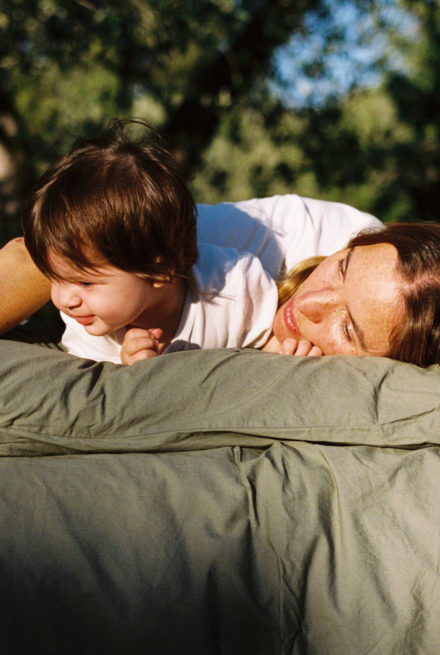
While we were at Emily’s home in Copenhagen photographing her and Clara, one thing stood out above everything else: how completely present she was with her daughter. When we ask whether that comes naturally, Emily answers immediately:
“It’s effortful. It’s not effortless. I try really hard. The world asks a lot of us. We go to work, we want to still have friends, we want to still be ourselves. But when children are two or three or four, there are only a few things that matter to them. They just want to be with you.”
She thinks it deserves particular attention.
“It’s not just about being present with her, but about being present with my own needs. And being honest about them – with myself and with her. I think that’s a real gift, especially for daughters: to see that their parent honours what she needs, instead of sacrificing everything. Because one day she’ll grow up and decide whether she wants to be like her mother, or whether she doesn’t.” She shrugs. “There’s no bigger motivation than that.”

“I think she’s coming to make us a family”
There’s a difference between the first child and the second, she says. Not in who they are – she doesn’t know that yet – but in what they do to the family.
“With the first baby, the change is that you become a mom. For me it was really about a major personal life shift,” she says. “With this baby I feel something different. I think she’s here to make us a family.” With one child, you can take turns – one takes over while the other does something else. “With one child you’re in many ways still primarily a couple, co-parenting one kid. With two, you think: okay. This is a little tribe. Now we’re in this all the time together.”
And on the question of how it feels to close the chapter of being a family of three, she answers without hesitation: “I grieved that closure a few months ago. It might come back and hit me like a big wave, but I feel like I’ve processed it.”
Will you let it change you?
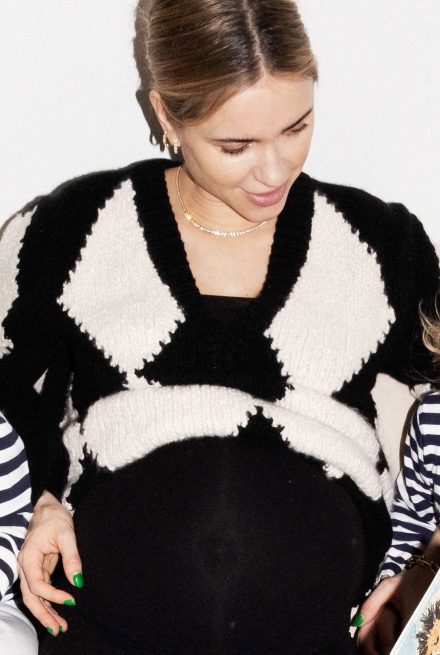
Emily rests her hand on her large, bare, sun-tanned belly. In a few weeks she will go through it all again. The same thing that changed her forever in Malibu – but this time in the house in Copenhagen. She is no longer the pregnant woman preparing down to the last detail for something unknown. She knows what’s coming, both physically and mentally. And now, as the family is about to go from three to four, she is very conscious of the approach she has chosen to motherhood.
“Choosing to be a mother is the most courageous decision you can make. I can’t think of a more courageous one – spiritually or physically. But once you’ve become a mother, there’s another decision to make: will you let it change you?”
She has not hidden what it cost her.
“It’s different for every single person, how motherhood changes them. And that is terrifying. Because it’s a step into something you don’t know.” She smiles. “And it’s one of the most remarkable journeys you can be on in your life. If you let it happen.”
This interview is an edited extract from our conversation with Emily Weiss. Listen to the full episode here.
Photos by Polina Vinogradova